Sailboat Sunday: Allmand 35

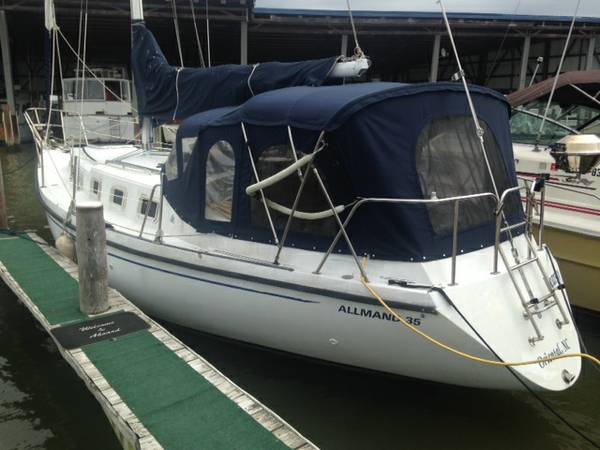
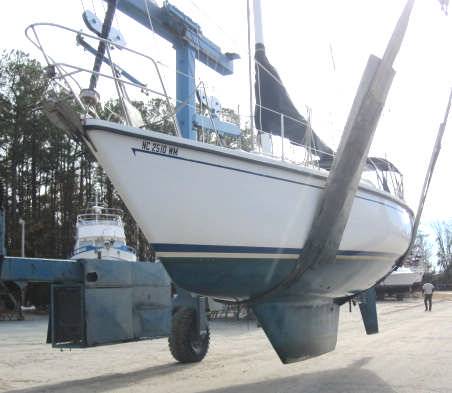
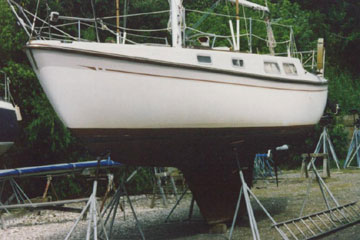
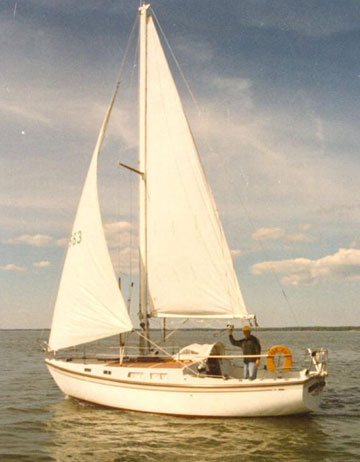
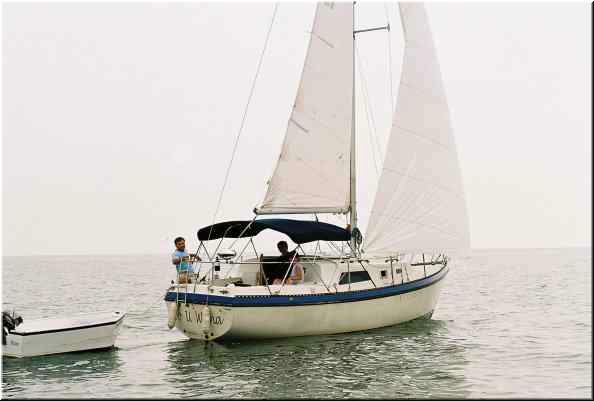
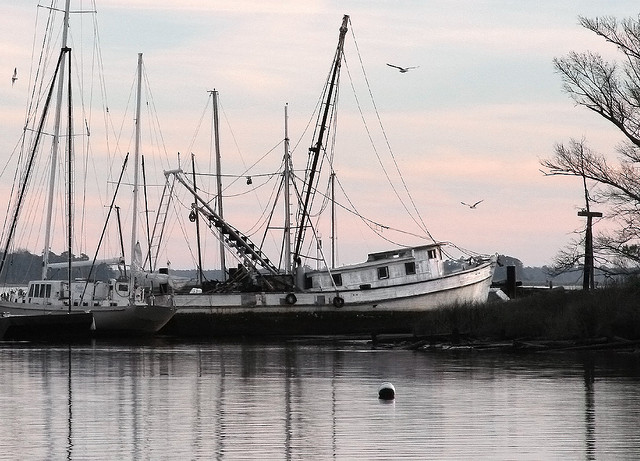
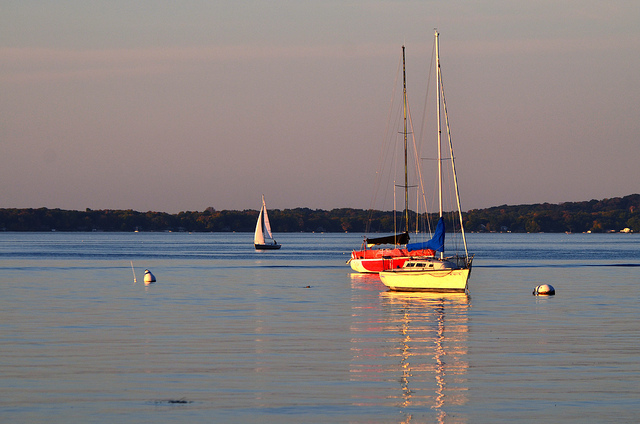
Trolling for sailboats the other week lead to an interesting find; an Allmand 35 listed for $7500. In the last Sailboat Sunday post we discussed an arbitrary and invisible line called “thirty feet”. Every once in a while, something will pop up for less than $10K (our fictional budget) that is over 30 feet in length. In this case, a sailboat that fits nicely in the middle.

I tend to agree, based on personal experience and observing several other liveaboards, that a well designed sailboat between 33 and 38 feet in length is a sweet spot. Small enough to comfortably single hand, not too hard on length-derived service costs (slips, haul-outs), large enough to provide unique spaces for life activities, reasonable chance of finding something with headroom (at six feet tall, I have a personal desire for this), and plenty of storage for reasonable needs.

Why do I say this?

  • My personal experience living aboard our Tartan 37, Persephone, led me to find it the perfect size. Safe and comfortable at sea too.
  • In Charleston, I had one neighbor on a Catalina 34; similar experience, in that he had everything he needed and incentive to leave it that way!
  • In Fernandina Beach I had a Westsail 32 as a neighbor. Again, great sailboat layout and one happy guy.
  • Search across the web for those who are out there: Webb Chiles (Ericson 37, She 36) and Bob Wise (Cal 34).

Allmand 35

So let’s see what’s for sale this week. In the Annapolis Craigslist, I found the following:

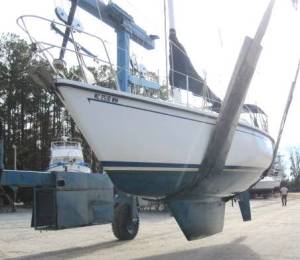
Allmand 35 – $7500

Features from the listing:


  • http://annapolis.craigslist.org/boa/4815130383.htmlhttp://annapolis.craigslist.org/boa/4815130383.htmlhttp://annapolis.craigslist.org/boa/4815130383.htmlhttp://annapolis.craigslist.org/boa/4815130383.htmlYanmar 27 that needs replaced
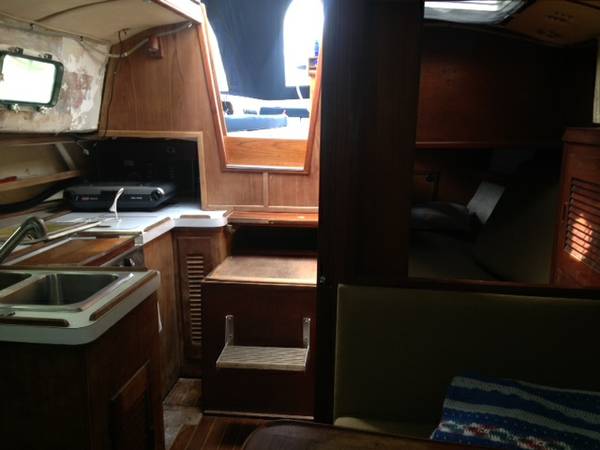
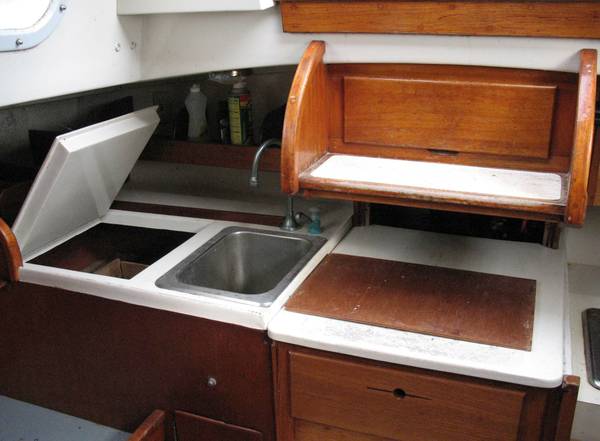
  • Oven/stove unit needs replacing
  • Last surveyed in 2011.

From the reference data, the Allmand 35 tri-cabin model has the following stats:

  • Length: 34′ 9″
  • Beam: 11′ 8″
  • Draft: 4′ 8″
  • Displacement: 15,100 lbs
  • Ballast: 4300 lbs
  • Fuel tank (stock): 40 gals
  • Water tankage (stock): 95 gals

What makes this a good potential liveaboard?

Bottom line: size. When approaching a decision like purchasing a home, especially a sailboat as a home, one needs to consider many factors. One factor I use is the “what can I change and what can’t be changed?” factor. Example: there’s no point in imagining a townhouse will ever become a stand-alone house. Without significant financial investment (i.e., buying the townhouses around you, knocking them down,e tc.) you will always have a townhouse. With sailboats, what are those factors you can’t easily change? Dimensions are certainly one of them. At this price point, and knowing what I do now, I’d consider this a reasonable trade-off. Plenty of space to enjoy now, and a targeted plan of how to restore systems over time if I was tight on funds. This is based on previous experience as well; our Tartan 37 sold for $6500 without a working engine.

The five foot draft means this vessel is capable of doing most all of the regular cruising grounds found in the East coast of America. Caribbean jaunts are definitely possible. And ocean-crossing capability is available with some additional planning and assessment. Rather than a “starter” boat, this could conceivably be a long-term home investment.

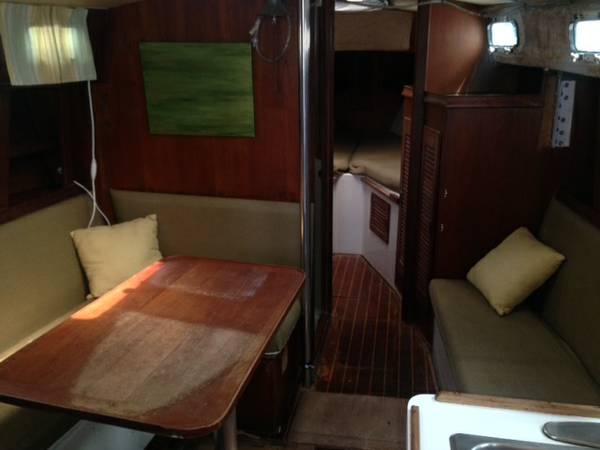
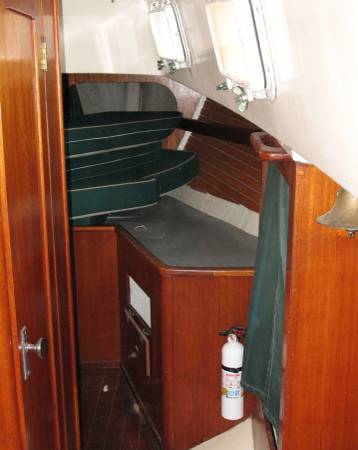
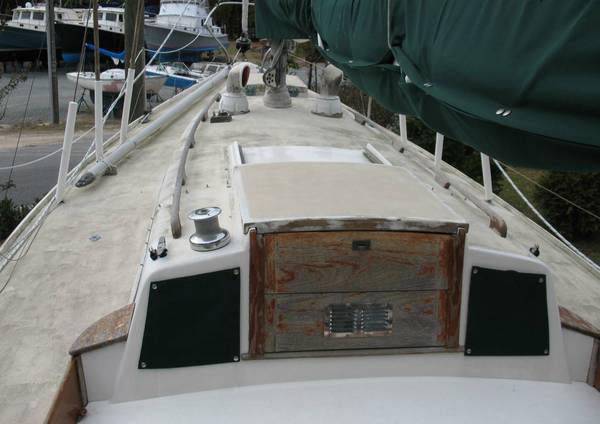
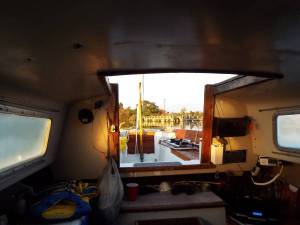
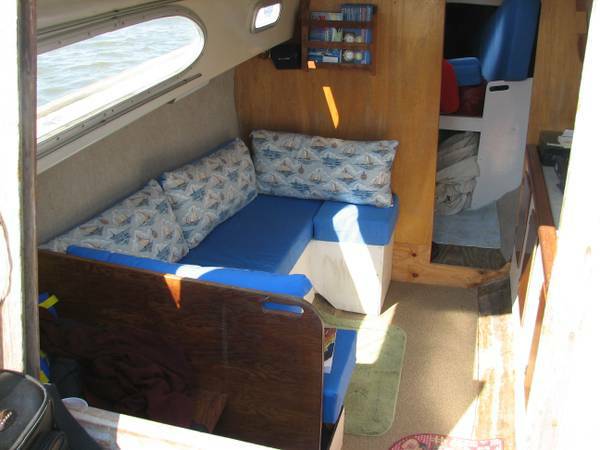
At first glance, much of the vessel appears in good condition. Stainless rails topside mean less maintenance. A nice enclosed cockpit area means additional living space (and a buffer against the snow if you lived aboard in northern climes). Some water damage below that needs looked to, but nothing impossible to overcome.

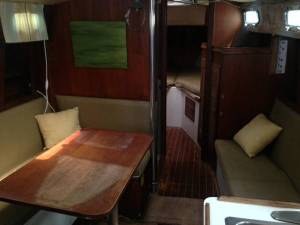
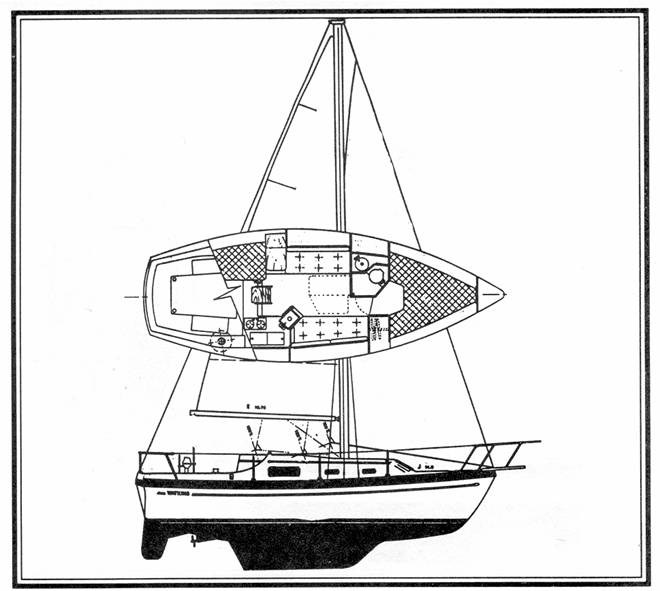
One feature I enjoy is the tri-cabin layout. V-berths are fine for sleeping in port, but not much good at sea. I much prefer to convert them into purposeful storage (sails, Rubbermaid totes, etc.). A quarterberth (a berth in the aft quarters of a sailboat) provides good motion when at sea, and quick access to the cockpit should something be going on. In this case, the aft cabin would also be fine for in port use, meaning no changes to sleeping arrangements while going to sea.

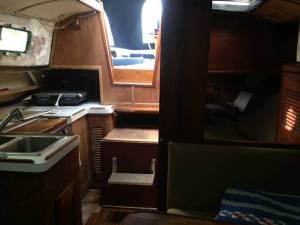
And the midship placement of the sink means a great galley layout for cooking both in port and at sea.

Additional information on the Allmand 35 can be found over at Sailboatdata and the design’s homepage

Factors to consider:

Price: Based on our fictional $10K budget, this vessel does push us right up to the edge without much margin. That said, this particular listing tells me that much of the sailboat is probably in good condition (relatively speaking) so that I only need to focus on a few significant items to be live aboard ready.

Engine: As mentioned, the seller assumes the engine needs full replacement. A qualified diesel mechanic would be a worthy investment to better make that call. If possible, we’d like to salvage and reuse what’s available, and as long as repair of the Yanmar is budgeted appropriately, it may be a worthwhile investment in time (not getting out there) versus money (using up our budget and saving for any additional needs). If this truly is a case for total replacement, then several options open up. This vessel is likely too big to effectively do an outboard-in-well setup, but one option could be a drop-down outboard such as Yves uses on his Alberg 30. Alternately, this could be a candidate for electric conversion, assuming the prop and drive shaft are in good condition. Or be ready to jump on a good engine replacement. As mentioned though, I’d consider this a reasonable purchase with a plan to sit in port for a year while steadily saving up for that engine replacement.

Floor: The cabin sole is listed as water damaged, and we’d need to see the extent of that. If the stringers (cross-members that support the floor) are in good condition, then replacing what’s there with a good solid plywood (marine grade or some of the well-bonded signage stock) and a non-skid floor covering is an option. I’ve successfully used an adhesive-backed vinyl with a tough tread pattern before; easy to install and maintain.

First steps:


As mentioned, the engine story needs told first. I’m 100% a fan of those who sail purposefully without engines. They can become a crutch. That said, for many they are also a worthwhile aid for convenience and an alternate propulsion.

Secondly, this boat isn’t that old (1984), and so many systems are probably in reasonable condition. I’d take the time to conduct a good solid hand-over-hand walk-down of the major systems (electrical, freshwater, engine) and create working diagrams of the components to see what needs replacing, what needs cleaning, and what works just fine.

Conclusion:

Sometimes a sailboat in this size range falls on the market, priced at a few thousand dollars, and it’s a turd. Lots of work necessary to get it into reasonable condition, definitely not sailaway ready. Truly where the term “Boat – bring out another thousand” comes from. That said, this particular vessel is one of the few that, for various reasons, comes in under $10K and is likely a good deal. Well appointed models may go for as much as $20K. So this could be considered a good invest. The potential downside being, if you make the purchase and start the work necessary to rehabilitate her, you are running down a clock called “interest in sailing”. If you know you have the long view, you can push through that period of time. But if you’re unsure, you may run the risk of loosing interest and then being the next person listing on Craigslist. And we wouldn’t want that!

https://vimeo.com/93014857

Video of a similar model that was for sale.
Commentary: Volkscruiser Discusses Philosophy

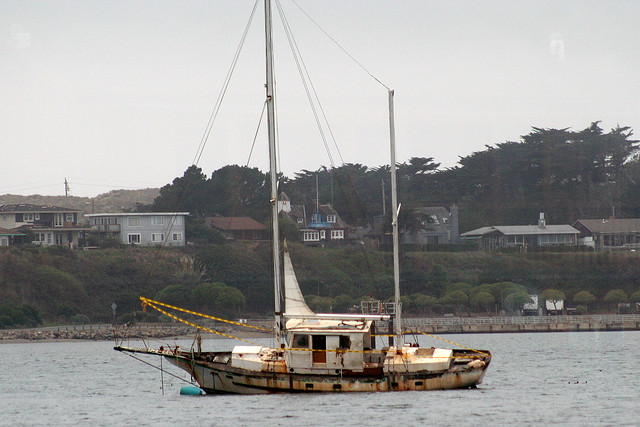
Bob runs a handful of sailing-related blogs, one of which is Volkscruiser. Earlier in February he posted a short article about some cruising philosophy titled: Volkscruiser: the question you need to ask yourself… 

In general, and at this time, I don’t intend to go into a lot of the philosophy one might have going into a liveaboard situation. There are plenty of places you can find that for yourself. Various cruiser forums abound with people’s thoughts on the matter, both the high level “for or against” and the very detailed “I’m thinking about this specific situation and want some opinions” variety. There is a mindset among those who chose to make a floating hunk of fiberglass (or other material) their dwelling place. The world will also have opinions about that choice, ranging from “Oh my goodness I wish I could do that” to “Oh my goodness your a full-time bum”.

https://www.flickr.com/photos/91829349@N00/1848665150/in/photolist-f5sijQ-7R5zzE-3PmTK5-83FaDe-fNALnB/

I especially appreciated those who said (or implied) that I was obviously too poor to afford a different living arrangement. Regardless of income or anything else, how do you explain to someone that you “chose” to follow a path less traveled?

As I read Bob’s words above, I reflected on the importance of understanding why I chose to live aboard. My personal belief is that intention matters in everything we do. I’m less likely to feel critical about someone’s stupid decisions (or the outcome of stupid decisions) as long as they are intentional in nature. Who do you feel worse for: the gal who invests it all trying to prove a hypothesis about cancer research, or the guy who foolishly loses all his money at a casino? Both are risks. One is calculated.

For myself, getting into sailing and living aboard while I was young (22) was intentional. I wanted to learn new skills, challenge myself, and live an interesting life. It paid off in spades down the line. During all of my subsequent job interviews, I never once heard “Oh my goodness, you took time off of the rat race to go sailing? We don’t want folks like that.” Instead, it was almost always “Holy cow, you did that? That’s amazing.”

The family that purposefully trades the 9-5 for a two year sailing excursion to spend time with their kids, exposing them to new adventures, is doing something intentional.

The couple who retire and then take their sailboat, lovingly maintained over the years, on an excursion to points south, are doing something intentional.

Just like we’re seeing in the tiny house movement, these kind of intentional stories abound. Even so-called circumstances, if approached in the right manner, can be decisions of intention. So what if your life situation changed due to events out of your control? What are you going to do about it?

Live a life of intention. You’ll be happier for it.

Photo: Credit of rjones0856

Sailboat Sunday: American Galaxy 32

Once again, life keeps holding me back from getting a good post it! And once again, like the Columbia 29 I profiled, this particular vessel came up again on Annapolis Craigslist. So fate suggests we should talk about it.

Any introductory book on cruising/sailing will have some discussion about hull form. It’s one of the easiest ways to distinguish sailboats from one another, and visually is most apparent when out of the water. As you may have guessed, it is also apparent when in the water from the perspective of performance. Different hull forms perform differently in different conditions. Each is a trade off of factors, with no “right” answer. That said, there are sometimes “better” answers for particular situations. The key components in evaluating hull forms, based on my naval architecture experience, are:

1) Hull section (i.e., if we cut a boat in half width-wise, what shape do we see?)

2) Keel attachment method (external vs. internal ballast, and the attachment method)

3) Rudder configuration

Each design factor deserves it’s own post, and I’m sure others have commented extensively on the subject. But for our purposes, consider these factors as we look at the following offering:

American Galaxy 32, $2700 

Features from the listing:

  • Built: 1959
  • Westerbeke diesel, 21hp
  • New sails in 2004

http://annapolis.craigslist.org/boa/4885621221.html

http://annapolis.craigslist.org/boa/4885621221.htmlhttp://annapolis.craigslist.org/boa/4885621221.html

http://annapolis.craigslist.org/boa/4885621221.html

What makes this a good potential liveaboard?

First, at 32 feet, the Galaxy gets us into a magical land called “over thirty feet”. In the sub-$10K category, this is a magic number to achieve. Why? Well, many sailboats built in the 1960’s and 1970’s were marketed as weekend family cruisers, and most were between 25 and 29 feet. While there’s nothing specifically wrong with this, the designers faced unique challenges. How do you fit everything a family might want for a “weekend” cruise in a small enough package to make it financially viable? Sacrifices were made, such as trading purpose-built storage for berths. To maintain visually appealing lines, most had low cabin heights, making the interiors challenging for tall folks.

Over 30 feet in length though, and now you get into an envelop where you can make some effective trades in terms of interior space use. I highly recommend “Voyaging on a Small Income” by Annie Hill, who advocated that their home-built 34 foot flat-topper, “Badger”, was about the perfect length. Not too long to incur unreasonable fees for length-derived services, yet easy to handle by one or two people. And big enough, compared to the high-twenties sailboat club, to make living aboard a reasonable experience.

Secondly, the hull form gives us a reasonable trade-off. While the fin keel requires some care (both in terms of maintenance and inspection to ensure a good strong fit and caution in sailing to prevent grounding), the skeg-protected rudder is a positive find. Especially in the waters of the Chesapeake Bay with crab-pots all over.

Lastly, the interior (as mentioned in the listing) isn’t too bad. Let’s see the details.

Some of the data on this model:

Length Overall 31.58′
Length Waterline 23′ (which translates to long, beautiful overhangs)
Beam 10.13′
Draft 5′
Displacement 11260 lbs

The Galaxy 32’s molds were sold and later used as the base for the Paceship 32. Bill Tripp developed both designs.

Factors to consider:

Certainly lots of things to wonder about with this specific boat, such as:

1) Price: This particular sale is from a sailboat non-profit who have listed the vessel several times. They are not looking for a project; they are looking for some cash in hand. This could mean a good deal for the prospective buyer, but will also mean the burden of restoration falls in those hands. At the same time, for our typical fictional budget of $10K, there’s plenty left over for a few well made purchasing decisions.

– Engine maintenance: Since this vessel already has a diesel inboard, we’ll assume it’s in reasonable shape and needs a good looking over. If it appears to need significant work (i.e., more than a mechanic giving it a tune-up after inspection), then we’d need to consider the inboard vs. outboard-in-well conversion discussed with the Columbia 29.

– Interior appointments: things likely all need a good scrubbing down (Simple Green, a bucket, and scrubby), but the cushions and other seating material, curtains, etc, may also warrant replacement.

– Navigation: a basic navigation kit would go far to bring this vessel up to reasonable cruising shape.

2) Liveability: Many sailboats built around this timeframe were designed for cruiser/racing. Meaning, the vessel could compete on the weekly race course (with appropriate handicaps per the class rules), but also suit a family for fun weekend sailing. The fin keel of this model jumps out at me as a racing design feature, which may mean the interior headroom is limited. Not a bad thing, but something to consider. Like my Cal28, I’d consider some kind of dodger setup to add at least one interior place where a person could stand at full height.

First steps:

Let’s assume our fictional budget of $10K and enter into a “What-if” scenario. The sailboat looks reasonable during inspection: it needs a good hard cleaning, but is structurally in good condition. Interior components are bonded together, fiberglass tabs are in good shape, and there’s no significant water damage. The engine is checked out by a local diesel mechanic who can turn it over; components are all in reasonable shape.

Engine: As mentioned, we’ll have someone do a service on the engine, cleaning the injectors and fuel lines, check compression, and any other maintenance. We can handle many other items, such as checking/cleaning strainers, giving it a de-greasing, and other simple labor. Bottom-line, once splashed, we want high confidence that the engine will be there to support us. And I’d purchase a model-specific manual as well as a basic diesel maintenance handbook, such as Nigel Caldwell’s.

Anchoring: Assuming like so many sailboats that the Galaxy only comes with a questionable danforth “lunch hook”, I’d consider what was needed to provide a suitable anchoring system for coastal cruising. In my mind, I’d need six components:

  • Suitably sized all-around anchor, such as a generic plow-style.
  • Long-length of galvanized chain as a primary rode (80′ or more).
  • Short-length (15′-25′) of galvanized chain to weight-down the secondary anchor rode.
  • (2) long-lengths of nylon line (100′ or more): the first for augmenting the primary chain rode and the second for the secondary anchor rode.
  • Shackles/thimbles to fasten everything together.

Having cruised successfully on 80′ of HT chain in a bucket from Home Depot, I’d feel comfortable doing so again. Many resources are online to size anchor chain and nylon line.

Electrical: Bob over at Volkscruiser wrote a great piece on the availability of certain kit for cruising which has come down in price in the past five years. In this case, using my fictional single dude from the Watkin 27 post, the minimum requirements for power aren’t too outlandish. For south of $1500 we could have a small solar array, clamps, wiring, two deep-cycle batteries, charge modulator & monitor, and LED’s for the entire rig, along with LED navigation lights.

Navigation: As mentioned above, we’d need to consider what a minimum navigation kit looked like for this vessel. Assuming again that we’re cruising coastal, staying in port for extended periods for work, and would only consider significant off-shore work with a more thorough evaluation, I’d suggest:

Bedding: along with the consideration of interior cushions and “apartment therapy” things, I’d also take a look at a nice 4″ memory foam topper, cut diagonally to support the V-berth or doubled up on one of the settee berths along with a quality sleeping bag. Perfect, easy to stow and use bedding for cruising.

Galley: One of my favorite reads was Tim Ferriss’ The Four-Hour Chef. With a copy of this, a skillet, a pressure cooker, a good santoku knife, and a set of Target flatware and dishes, I’d happily head across any ocean. Especially with a stainless kettle and Aeropress for coffee, along with the Hario hand grinder.

Conclusion:

I could see a very enjoyable post-college, first-job, using-for-sabbatical scenario with this vessel. Over a few years it’d be a good platform to figure out “Do I really like this enough to consider something bigger/newer/better/whatever?” Or learning that this really is all you need to do some amazing cruising and lead a “World’s Most Interesting Man” lifestyle.  I recall reading about a group of friends just out of college purchasing and refitting a Newport 30 for just such a plan. This would be nearly identical. As always, take the above with the appropriate grain of salt, as it’s one person’s opinion and not gospel.

For further information:

Galaxy 32 Sailboat Data basic coverage

Paceship 32 Sailboat Data basic coverage

Paceship 32 owner’s group

 Google search for the Galaxy 32

A Galaxy 32 is about to come into frame at 2:44.

Serenity or the Millennium Falcon: Choosing My First Sailboat

What did Malcolm Reynolds of the hit TV series Firefly and Han Solo have in common? Well, I’d venture to say they both loved their ships. And that is a very important part of owning your floating home; if you don’t love her, she’ll be worth less than that dollar menu hamburger.  After all, love keeps her afloat…or in the air.

That said, there are several factors which influence the decision of which sailboat to buy. The most important thing to remember is this: there is no perfect boat. I repeat, there is no perfect boat. Every boat is a compromise between these factors. The key is to know where you’ll compromise, how much you’ll let those factors change, and your will power to let that be OK.

  • Money: Let’s get this out of the way. A sailboat will cost you money. The question is, how much up front, and how much to keep her? We’ll continue to delve into the holistic finances of sailboat living over the lifetime of this site, but looking from 10,000 feet, you need to think through:
  • How much will my purchase cost be, including any taxes, registration fees, and broker/dealer commission? You need to know the immediate cost if you agree to buy.
  • What are the average operating costs going to be? It’s usually best to think of these in terms of per-foot costs. Slips are typically priced on a per-foot basis, as are hauling out fees to get her on land for repairs, some insurance products, and others. This is also the place to think through the totality of your live aboard experience. If you don’t know where you’ll keep a boat, you’ll have a harder time making a rational decision, especially on size.
  • What are the estimate costs to complete necessary and desired improvements? There’s going to be something, it should be prioritized, and you’ll most likely be 50% off. But these are real costs too.

This post was previously setup as a high-level synopsis of all of our sailboat purchases, but I’m re-purposing it into a detailed look at my 2002 decision to buy my first live aboard, a Cal 28 flat-top named SeaWitch.

My new bride and I while I was moving off.

A Bored College Student

Well, maybe not bored, but unsatisfied. March of 2002 I took off with my girlfriend for spring break in London. A topic of conversation was my plans after graduation from the U.S. Naval Academy. Like my classmates, I would soon graduate and gain a commission as a naval officer, specifically a submarine officer. My next duty station would be Charleston, SC, to attend nuclear power training. Many of my friends were looking into various living situations: apartment complexes, buying a starter home, the decision of living alone versus roommates. Decisions every college grad will face. In my head, these seemed like perfectly fine things, but I really wanted to do something different.

A project mentor planted the seed in my head about living aboard a sailboat. His girlfriend and he were doing the same thing. He had many good things to say about it. Thus, after returning from England, I got to work doing my research. A guy in my unit grew up on the Chesapeake Bay and had a small 19 footer. I could take a look and maybe even spend a weekend aboard just to trial run things. I began checking out sailing books from the library, and spent hours searching through the limited online offerings from fledgling websites of cruising. My roommate was on the sailing team and had some thoughts as well, and my previous summers sailing for professional training helped frame some of my thoughts.

Fundamentally, I worried about the following things:

1) How big or small of a sailboat did I really need?

2)  How much boat could I afford (both initially and on-going)?

3) What hurdles existed between sitting in my dorm room and being a “successful” live aboard?

The Challenges

At the time, several significant challenges existed which have largely been mitigated over time. Things such as:

  • How do you find sailboats for sale? The local classified ads in newspapers and the beginnings of some online brokerage sites were all that I had available. In the end, it was foot work and driving which led me to the Maryland Marina in Essex, MD, where I did my first surveys and eventually bought Seawitch.
  • How to purchase a sailboat? Thankfully my person bank had several options for boat loans, and my personal savings helped to supplement.
  •  How do I figure out all of the unknowns? I made a few “blind” purchases of recommended cruising books, hoping to gain the knowledge necessary to answer my unknown questions, and relied heavily on the experiences of others gained through conversations and the internet’s early forums. Much of it was valuable, much of it was suspect. I had to sort out a lot of chaff.

Finding My New Home

In April of 2002 I arrived at the Maryland Marina on a reasonably warm Saturday. In hand were color printouts of several boats they had for sale via their business webpage, a small toolkit with tape measure and flashlight, and a notebook. Sadly, digital cameras were not really as available, and I may have brought my super awesome Canon ELPH with drop-in film.

I asked the manager if I could spend a few hours looking over the sailboats in question. No worries, he said, and tossed me keys to each of them. The entire afternoon was spent crawling over each of three offerings, probing the recesses of bilges and under lockers. I learned a bunch that day, including:

  • Finding a sailboat under 30 feet with headroom for a tall guy was practically impossible.
  • Finding a sailboat in my price range over 30 feet was also unlikely.
  • The smell of musk in a locker would be ingrained in my mind forevermore.
  • While it would eventually feel much smaller, a 28 foot sailboat on stands looks huge.

After noting as many of the features as I could during my personal survey, I returned the keys and asked for contact information for two vessels. The Cal 28 had risen to the top of my short list.

A Cal 28 on the hard; similar to the one I found in Maryland
cal 28 (4)
The Cal 28 sailing (note the dodger over the companionway; something I always wanted but never got around to)


After two phone calls and another afternoon going over the boat with the owner, I made the decision to buy SeaWitch for the sum of $8500 (2002 dollars).

Resources for those interested:
Stirling Law’s Cal 28 webpage; still the most comprehensive of any on this model

The Next Step of My Future

Back to the factors listed above, I financed my first liveaboard, so thought of things in terms of both monthly and total costs. SeaWitch was sold to me for $8500. Taxes and registration came out to around $400. I was responsible for the launch fee, since I would liveaboard on land for several months due to my work schedule. $400 for launch and getting the mast back up. The seller paid the seller broker fee, and I was not represented by a buyer’s broker, so no fee there. Total initial outlay: $9300. My note was for slightly more, with a monthly payment of $230.

At 28 feet, my per-foot costs remained pretty reasonable. My slip in Charleston, SC, was around $10/ft plus metered electricity. This averaged $30-40 per month. Cable TV was included (although I’m a proponent of doing without that burden), and for internet I needed a telephone line for dial-up, adding another $30/mo. Total cost to have a slip, parking spot for my car, electricity, water, phone and cable: $350/mo. This is $4200/yr

My plan was to haul out every other year to do maintenance on the bottom and tackle any odd jobs. Asking around the marina, I reasoned the total cost for haul out, storage on land for a week, and launch, would be around $500. There was a yard I could do my own work at (becoming rarer these days), which would have saved me some money. Including bottom paint, total bi-annual cost: ~$1000.
If you amortize that, I needed to save about $40/month for that cost.

Lastly, upgrades. All the normal items came with the boat: sails, engine, safety gear to pass a USCG inspection, and some interior accouterments. But to make her a liveaboard, I needed a number of “home” items, including dishes and kitchen ware, bedding, painting the interior, some rugs, and several small pictures and knickknacks to call it a home. I was also moving to the South, and I quickly realized living without A/C there was trouble. Then it turned to winter, and I needed to buy a couple of heaters. These small costs can add up quickly; like several hundred dollars in the first couple of months. I also had a running list of marine upgrades to better the boat itself: changing out from a portapotti to a marine head, adding better sail controls, and the worst offender: maintaining, and then replacing, the Atomic 4 inboard engine.

By the end of the first year aboard, I had spent an average of $300/mo on these kind of “extras” that ballooned out of control. Again, I hope to cover some of my “lessons learned” in future posts to discuss items I purchased, why they did or did not work, and the actual value of them.

One of the Best Decisions of My Life

Ultimately, the decision to move aboard was probably one of the best in my life. Some of the reasons were tangible, but most were related to those influential experiences a young man or woman can have.

  • I learned very quickly what a spending plan was and why I needed to keep to it. Owning your own home has costs and they must be managed.
  • I learned to become more self-sufficient and a generalist. You can’t call the landlord and complain about a broken water pipe; you need to fix that quickly or else you’ll sink! Living aboard provided many opportunities to learn new skills, practice new abilities, and make decisions that had significant consequences.
  • I learned to ask for help. While I tried to do as much as possible on my own, I also had a community of sailors surrounding me who were readily available for help and advice. I learned more that first year from them than anyone could possibly gain through reading magazines, books, or articles online.
  • I learned about myself. During a handful of significant experiences, such as grounding the boat, a fire aboard, several near-sinkings, and facing the choice of sending my delivery crew home and continuing on solo, I had more opportunities to grow and learn about who I was than every before. These seminal experiences ultimately helped shape who I am today, and continue to be a source of positive influence on my life.

In a future post I’ll detail the same process that led to shifting resources away from the Cal 28 and towards a new future with our Tartan 37, Persephone, over on the island of Guam.

Note: Due to the poor timing of technology, most of my pictures of SeaWitch were either on film or my first digital camera, which were destroyed during several events later in life. I hope to recover some photos from friends or otherwise and add to this post later if possible. The glory of having a camera on every phone these days; one forgets how convenient that really is.

Photo credit: From the Stirling Law Cal 28 website, SailTexas advertisement, and my own collection

Sailboat Saturday: Columbia 29

While I’ve been delayed in writing this, the post on Craigslist continued to be available. Perusing the internets for a fun sailboat to highlight I found this ad for a Columbia 29.  The basic specifications:

$1500 o.b.o.
1964 Columbia Sailboat Model C-29
1997 15 hp Honda Outboard – runs great
Presently on the hard
Includes five jack stands

Columbia 29 sailing


Columbia 29 on the hard

Columbia 29 interior

Columbia 29 settee

What makes this a good potential liveaboard?

Well, a few things stand out to me. First, at 29 feet, this is slightly larger than the Cal 28 I lived aboard, making me just a little bit size jealous. It’s a good length for single-handing, and the layout down below appears to be usable in the same capacity.

Also, the hull form is something you won’t find being used much in newer vessels. A decently long keep with a protected rudder. See the layout drawings found at one of the Columbia 29’s owner websites here.

Some of the data on this model:

Length Overall 28′ 6″
Length Waterline 22′ 6″
Beam 8′ 0″
Draft 4′ 0″
Displacement early 7400, late and MkII 8400 lbs.
Ballast (lead) early 3120, late and MkII 4100/4120 lbs.
Fuel Capacity (with inboard) 12 gal.
Fresh Water Capacity 35 gal.
Sail Area 382 sq. ft.
Head Room 6′ 0″
Power – Concealed outboard well (standard), Inboard 8 HP Palmer (optional)

Note that last point, a big seller for me: an outboard well. In this case the specific boat had an outboard mounted on an external bracket. Not bad, but not great either. In my estimation the outboard well is one of the most unappreciated features in these 1960-1970’s era sailboats. Check out James Baldwin’s excellent builds over at Atom Voyages for examples of this feature being added in after market.

Factors to consider:

Certainly lots of things to wonder about with this specific boat, such as:

1) Price: given the low selling price ($1500 at the time I’m posting this) my spidy-sense is kicking in. Part of the price is due to a desire to sell quickly, but this also likely means there’s equipment missing or in need of replacement. Much like the Watkins 27 we looked at early, I’d look into what basic equipment is already provided and the state/health of these things. If I had a fictional budget of $8000-$10,000, there’s probably a lot that could be done. Such as:

– Buy a good gallon of epoxy and fillers to tackle any fiberglass projects that would crop up. It’s easy to learn to use, and given the vessel’s age there’s likely a number of holes and areas which could benefit from some structural loving.

– Electronics: I’d like to think I’d be cautious, but given the age and potential budget, there’s probably a lot that could be done to add some modern conveniences where they are absent. A good depth sounder, compass, and maybe a small chart plotter wouldn’t break the budget and could be found used on eBay or with further Craigslist searching.

– Propulsion: given the low price, I might consider changing out the engine. The 15hp would likely fetch something when sold, but a newer model high efficiency/high thrust long shaft would be a nice-to-have feature and probably better mileage. Brand new with controls and such it may run into the $3000 range, but is worth the money.

– Liveability: Much like the Watkins we covered, some self-sustaining gear to provide a better liveaboard situation, such as solar or wind power, possibly an additional deep cycle battery or two for house loads, and maybe a DC-powered freezer/fridge unit.

Of course, the trouble with low-price fixer-uppers is being honest about the need-want decisions. A diligent owner could really stretch their dollar and get a lot of boat for their money. At the same time, it’d be easy to sink a bunch of cheddar into low-priority fixes or conveniences which don’t improve the value or utility of the vessel.

In closing, there are a few other Columbia 29 resources I found. Given this one is on the hard, in a perfect setting to give it a good survey and dig into any problem areas, there’s a lot of potential for this particular vessel and this model in general. Sta y tuned for the next installment.

Sailboat Data basic coverage

Write-up at Bluewater Boats

Sailboat Saturday: The Watkins 27

In an effort to become more consistent with posting, I’ve wanted to get into a rhythm with a basic post format. One that stuck in my head was to write about the most enjoyable time waster I know; trolling Craigslist for new sailboats!  I can’t explain the pleasure that exists in researching all of the “What if?” thoughts that come with finding a diamond in the rough.  Sometimes the sailboats are in great shape and could sail away today.  More often, they need some love and tenderness to be brought back to their full potential.  And in those cases, there’re many examples where a frank discussion on prioritizing could be beneficial.

The structure of these posts will attempt to do a few things:
1) Describe the “avatar,” or situation and person who might be looking at this particular style of sailboat.
2) Describe why the particular sailboat in question could make a good potential live aboard for that situation.
3) Key factors to consider for the person looking into the sailboat.
4) And lastly, a few recommendations for first steps after the sailboat was purchased.
So, let’s talk about the Watkins 27
Situation:
I’m a 23 year old college graduate, just out of a computer science program and moving to coastal North Carolina for my first job.  I’m just about 6′ tall, like to run, and enjoy playing video games on the side.  I learned to sail while in college, but haven’t ever owned a boat before. I’m looking for an adventure post-college, and figure this may be a good way to spend a few years before moving on to my next gig.
A Classic Coastal Cruiser
The Watkins 27 first came to my attention in 2009.  I was in the process of selling our Tartan 37 over in Guam, but sitting around in Maryland waiting for my new job to start. It was killing me.  The thought train circling my head kept saying “Well you could just buy a sailboat now, mooring it out in the Chesapeake, and enjoy unemployment for a bit.”  I knew I wanted something smaller than the Tartan 37, and the 27-30 foot range was ideal.  Then a Watkins came up.
http://www.watkinsowners.com/albums/w27/index.htm
Watkins 27 Under Sail
This week, another Watkins popped up on Craigslist. Basic information includes the following:
Price: $6000
Year: 1979
Size: 27′ long, 10′ beam, 3’8″ draft, and 6’2″ headroom
Equipment: All the standard sailboat gear (head, alcohol stove, fridge/cooler, 2 way VHF radio, AM/FM/CD player…)
Engine: Yanmar YSM12 with some recent work completed
Sails: Main sail, storm jib, genoa
Bonuses: Garmin GPS 2006C with navigation cards; wheel steering
What makes this a good potential liveaboard?
1) Headroom: When analyzing a sailboat purchase, consider all of your decision factors with this criteria: what can I change after I purchase the boat, and what am I going to be stuck with?  Two in particular are headroom and draft.  Without substantial modification, these will be fixed and unchangeable.  The Watkins is one of the few sailboats under 30′ that boasts this kind of headroom.  And as a 6′ guy who lived aboard a 5’10” Cal 28, I can tell you how enjoyable having that kind of flexibility is.
2) Draft: Along the same lines as headroom, this boat draws just less than 4′.  Perfect for cruising the barrier islands of North Carolina and more than capable of cruising up or down the East coast of the U.S.
3) Equipment: For $6K you’d get a Yanmar diesel engine.  In the end, if a sailboat has a working diesel engine, you are probably better off keeping it and maintaining it in good condition than changing it out.  I personally subscribe to the philosophy of Yves Gelinas’ Jean de Sud and James Baldwin, and enjoyed several sailboats converted from gasoline inboards to gasoline outboards.  I wouldn’t consider a replacement diesel unless it was a great deal, for this particular size and age of sailboat.  After all, you could likely spend over $10K in a new installation, more than the cost of this boat in the first place.  But, with a working diesel you could consider some well thought out upgrades to make sure it lasts you a good long time.
4) Build/Layout: The Watkins is a pretty solid coastal cruiser.  It has a wider-than-average cabin, good coamings in the cockpit, and (to me) appealing lines.  One of the nice conveniences to sailing, wheel steering, is included in this model. And the arrangement below decks would support having a computer station in the settee, using the table.
http://www.watkinsowners.com/albums/w27/index.htm
Watkins 27 Layout
Factors to consider:
Other than the typical survey checklist, a few items I’d be concerned about during my in-person inspection:
  • Engine condition: Again, one of the appeal factors is a good condition diesel engine. I’d want to know how it was used, maintained, and what the state of the entire system is (fuel tank, hoses, exhaust, cooling, etc.) When in doubt, have a mechanic come by to assist.
  • Steering cables: Duck into the cockpit locker with a flashlight to inspect the condition of the steering system. While steering by wheel is convenient, replacing the cables is not. That said, it’s completely within the realm of the do-it-yourselfer to replace these cables if necessary.  Keep an eye out for cable wear, broken strands, and corrosion on the turning blocks and quadrant.
  • Sails: The listing didn’t specify, but this is a pretty stock set of sails.  Check for wear and tear, fit (raise them up to verify the size is accurate), and for versatility: how many reef points does the main have? What condition are the batten pockets in?
Most of the equipment list is pretty stock for a boat of this vintage.  One should expect to see the typical boat gear necessary to get out and about safely. This post isn’t meant to be exhaustive of a pre-purchase survey, and a well informed buyer will do a thorough job of inspecting the entire boat.
Next steps:
A few things I’d consider:
  • First, ensure the top five priorities are met. See Attainable Adventures for more detail, but until confident of these, I’d forego any significant modifications.
  • Power: Depending on the context, being self-sufficient in power production is the next step I’d make. Solar panels on the stern or sides of the pushpit railing, or on deck, would make a big difference.  A wind generating system may also be valuable depending on the intended location.
  • Dodger: In this case the boat came with no additional covering, and I’d posit that a dodger should be the first item on the list. At anchor or in port a simple boom tent could be rigged to reduce heat from sun glare, but a dodger would allow full headroom and movement even in increment weather. And be a luxury when sailing out of Cape Fear into the rolling surf!
Caveat:
 These are my thoughts, not gospel. Each person’s situation is unique, and each sailboat is different. Just because something is possible to do, doesn’t necessarily mean it’s the only way to do things or even the best way!  Consider these good entry points and thought-drivers.
So… any other sailboats you re interested in? Shoot me a note in the comments and I’ll keep my eye out in the Craigslist listings.  Stay tuned for the next installment in two weeks.


One Year in Djibouti: What the Desert Taught Me About Living Aboard

That big dreams are hard to chase, but everything worth doing is going to be hard work.  And that’s an understatement.

In July 2013 I departed my typical East Coast lifestyle for a one-year deployment to Djibouti, Africa, with the U.S. Navy Reserves. Initially I had high hopes for compartmentalizing my life; work hard at my duties, but also focus on getting this sailing resource up and going. Build some discipline about posting regularly, maybe front-load some products. Of course I’m Superman and can do everything, right?

In the end, I spent an inordinate amount of time doing my primary duties. And that’s not bad; I was assigned a mission and we accomplished it. My responsibility was to the American tax payer, and they got their money’s worth out of this guy.

And so I begin what we affectionately call fiscal year 2015 back here in the states. Two years of web hosting in the hole. Time to buckle down and determine some direction.

Which led me to think of the subject topic. Like many people I try to deliberately take time to reflect on where I’ve been, where I’m heading, and how the in-between worked out. While living aboard my Cal 28, and while cruising on my Tartan 37, I often practiced the same analysis. What kinds of lessons were learned during the previous period? This provides invaluable support in making solid, reality-based, and challenging decisions which have a high likelihood of success.

Lessons Learned

1) This Isn’t Kiddie Soccer: One of my favorite bits of advice started that way: “This isn’t kiddie soccer; you can’t just try hard and mean well.” In our case, lives were legitimately at stake, so decision-making in an uncertain environment was a vital skillset. When I think on my sailing skills, the same thing applies. The decision to stay out and buckle down through a weather system has real consequences. The choice of type and manufacturer of essential pieces of kit are likely to become critical when truly pressed into service at the worst possible moment. And when solo-sailing, each decision provides the foundation for whether you return to shore or not. Not to say these are impossible situations, but I gained a deeper appreciation for how real the real world is.

2) Dry Your Eyes Cupcake: I worked with a great British chap who shared this statement: “That’s why I say: Dry your eye’s cupcake and soldier on.” Rather harsh response to the particular topic, but the line was catchy when tossed around with an accent. When our Cal 28 sank due to a catastrophic failure of the rudder bearing, we didn’t have time to mope around and feel bad. Time mattered, and we quickly got the boat into a safe location and promptly got a salvage crew to assist in raising her before she became a navigation hazard. When the shaft gland cover sheared off enroute from Annapolis to Charleston, in the middle of a tight schedule, and with crew who had to leave me to continue solo for half the trip, I couldn’t just sit around feeling bad for myself. Emotions will certainly happen, and grief, fear, and anxiety have the capacity to overcome us. The best thing we can do is stop, assess the situation, determine what the next action is, and get on with it.

3) If You Want To Go Far: A common African proverb we heard was “If you want to go fast, go alone; if you want to go far, go together.” I believe there’s much to be said for that. Not at face value necessarily.  Certainly a well prepared solo sailor may chock up more miles than a family with more shore-side baggage (not necessarily a bad thing either.) We all need help from someone. It may be words of encouragement, a helping hand with a project, or a spare set of eyes during a passage. My favorite memories of living aboard SeaWitch, and later at the marina in Guam on Persephone, was the friends I had and relationships we shared.

A year on the dark continent was certainly more than I expected to achieve in my life. It was a tough tour, and while I managed to get a stand-alone site up and going, was unable to spend the time necessary to reach my goals last year. But I hope the lessons I took away from Djibouti will continue to shape my actions and goal-setting for years to come, and be a positive influence on how I sail.


Freecycling: Should I Even Consider A Project Boat?

Boat Graveyard

Bob over at BoatBits has a short note this week that struck a chord with me.

Every boat I’ve owned was used. My most recent one, a Balboa 23, was “free.” The thought process for me was rather simple.

1) The Balboa, while free, would have some initial expense. This came in the form of sweat equity to get it out of the water, a small ramp fee to do so, and the cost of discarding the hull of my Aquarius 23.

2) Sweat equity and lost sailing time from removing every piece of kit from the Aquarius 23 to later be installed on the Balboa 23 (same model boat, just slightly upgraded interior.)

3) The typical friction inherent to any project, where lots of decisions need to be made, time sucks, learning curves, etc.

The reward was practical: for little initial expense, I was getting a significant boost in interior renovation. The Balboa, while lacking many items, had a great interior that was much farther along than my Aquarius. I knew I’d sink a lot more time and money into the Aquarius interior before it would be up to my desired standard. I figured I could short cut a little bit of the process.

That said, it wasn’t easy to get everything in order to go sailing that season. I only made it out once in 2012, and it was over Veteran’s Day. In Maryland, the daytime might have been comfortable, but the nights are quite chilly. So much for opportunity.

Every once in a while on Craigslist there will be a “diamond in the rough”. That potentially great deal, which like a siren calls to a mariner. “Of course you can have this 40 foot world-girdler for the low price of $1000,” while the reality is there’s a significant outlay to be made to get her in good condition.

Then again, a patient person, with the right plan, and a large degree of self-restraint, could pick up such a boat with the intent of doing things slowly over time.

Frankly, that was the plan for our Tartan 37. A sailboat we could keep as long as possible, and just keep doing small upgrades over time while maintaining the basics. I can say from experience it’s a tough position to be in. If you are considering a project sailboat (a significant project sailboat; they all need something), then please heed Bob’s words.

(Photo Credit: Clicksy)

Consumerism and Sailing: An Almost Impossible Match

Buy Krap

Today’s thought comes from viewing a great video over at Doryman (and here), who links over from Annie Leonard’s site. The discussion is on consumerism, and it got my creative juices going. Not that I have an “audience”, but I suppose I have a platform.  If you find yourself with twenty minutes, grab a snack, a coffee, a whatever, and watch.

I was initially turned onto these types of short documentaries by the 35 minute film There’s No Tomorrow.  Since we don’t have cable, I don’t get to watch a ton of Discovery or Learning Channel, and these Youtube-style versions are filling the gap.

When I think on what consumerism is, I’m reminded of lessons learned from living aboard.  The plain fact is, there’s only a finite amount of room aboard any sailboat. It will be filled, in some way.  Maybe it’s chock full of foodstuffs, chock full of friends, chock full of junk, but it will be full of something. As a liveaboard, this is your environment, so you must learn to make wise choices on what comes in, what stays, and what goes.  Since your environment is small, and ever close, you quickly learn this lesson.

– You purchased the boat and it came with a typical assortment of 1970’s era life jackets.  Do you replace them out of concerns for safety, or because they smell musty, or because they look awful?

– You graduated college with your old 13″ tube-style TV.  Do you give up cubic feet on the boat to keep the TV or pitch it and get a flat screen?

– You want to refresh the look in the main cabin, but do you throw away the old cushions and replace, or recover what you’ve got.

It’s easy to think that these questions revolve solely around money. If I can afford to replace the life jackets with newer, safer models, I should. The TV probably uses more power than I can spare, and the cushions are full of evil chemicals; replace them all.

As a sailing consumer, we need to think about the other aspects of those decisions.  What is the impact of getting this _____ onto the boat, and what is the impact of taking _____ off the boat.


The Decision Two-Step

For things coming on:

  • Does this item serve a necessary purpose?
  • Will this item serve multiple purposes?
  • Where will this item live? Is there a space aboard for it?
  • What is this item replacing?
  • What additional work will having this item bring on me?
  • Will I get a substantial relative value from having this product aboard?

For things going off the boat:

  • Where is this item going to?
  • Can this item be reused aboard my boat?
  • Can this item be used aboard someone else boat?
  • Can it be recycled? (And where will I do that?)

Here’s an example from my Tartan 37.  The head was vintage 1980, with a substantial amount of plumbing missing.  I was overseas and getting parts would be problematic.  I wanted a bulletproof system, and went with a camper potty.  For the inbound toilet:

  • I had to “go” somewhere, so it was very necessary
  • It had its own water tank, holding tank, and seat, so I didn’t need to buy multiple pieces to create a system
  • It would be in the head, exactly where the old toilet bowl was and was measured to fit
  • It replaced the non-functioning marine head
  • I would have to purchase holding tank treatment and a spray bottle of cleaning solution, and later chose to keep some air freshener in the space. These were consumable goods that needed a life cycle decision of their own
  • Compared to ordering, shipping, installing, and maintaining a marine head system, this would allow me to do less work and have a lower potential for system failures, therefore provided substantial value

For the outbound toilet

  • The toilet had a number of copper fittings which could be recycled: off to the metal scrap yard
  • Sadly no, and what plumbing was left was of no value to me
  • In this case, no, because the head wasn’t rebuildable
  • Yes: at least the fixtures were and went to the local scrap yard

Most of your purchases should get this level of questioning before coming aboard. Protect your space, because many folks out there want to take it from you.

(Photo credit: Miz_ginevra)

The Zen of Arrival: Sailing for Mindfulness

Anchored out

One important concept in the practice of Zen (a school of Buddhism) is “mindfulness”.  This state of being can be described as an increased awareness of the activity at hand and the world around oneself.  So often in life we bustle through an activity without really thinking about what, exactly, it is we are accomplishing. That’s not always a bad thing; in his short book called Godliness Through Discipline, Jay E. Adams describes the ability of all humans to develop habits.  He uses an example of a man going through his morning routine to drive this point home. If you had to think through each and every action to accomplish your daily tasks, you’d hardly finish getting out the door before night fell. “First, I pick up the toothpaste tube. Then I reach up to grasp the cap. Now I turn it counter-clockwise…”

On the other hand, sometimes we rush through activities without giving them any thought. While I’m glad I don’t brush my teeth as just described, I am grateful I have teeth, that they are straight, that my parents ponied up no small amount of their income to get them that way, and that I can enjoy corn on the cob with them.

Certain boating skills can become this way, and one of my personal favorites is anchoring.  You will hopefully practice anchoring enough that many of the actions will be habit.  You will also train your mind to be constantly assessing any given anchoring situation, looking for danger, aware of your surroundings.  But hopefully you’ll be able to incorporate a sense of mindfulness in this activity.  It builds connection between yourself, the boat, the harbor, the ocean, and the world.  And that’s no small thing!

“I’ve spotted the entrance channel I intend to come in through. Track looks good, depth looks good.  Depth sounder is on and we’re safe.  How is that wind?  Ah… gentle breeze on the beam.  Feel the wind brush my cheek, rustle the sail, ripple the water.  Deep breath in, hold, slow exhale.  I grab the railing and get up from the cockpit, walking up the port side to the bow.  Feel the motion of the boat as we move together.  Feel her strength in my hands as I make my way forward.  Loving, diligent hands made her many years ago. Did they expect her to be sailing at this time?  Into this harbor?  I reach the foredeck and kneel down.  The anchor is lashed down with good strong rope.  I untie it, getting it ready to plunge into the darkness beneath us.  From some unknown mine, maybe in Asia, maybe here in the United States, we delved deep for the ore that birthed this instrument.  Who were they? What price did they pay to deliver the material to create this thing?  I look out at the surrounding water, seeing the small wavelets, listening to the sounds.  The image of the chart is in my mind, and I look around me to verify, yes, I’m still on course.  Some engineers created the magic that keeps my boat slowly moving forward, guided by a small electric motor, slowly left, slowly right.  I remember the number on the chart.  I need ten fathoms of line.  I reach down and pull out the anchor line stopper, unhooking the bitter end from the plug.  I stretch my arms out; one fathom, two fathoms… I feel the twisted strands brush across my hands as I pull more and more out.  This line has served me well.  How many anchorages has it kept me safely in? How many times has Zephyr or Boreas tried to blow us out to sea, or onto shore, and this line kept us safe? I check the markers on the line; yes, that will do.  I shackle the anchor and chain and line together.  I test each connection to make sure my mind and hands worked together, that each shackle is moused, that each connection is true.  I fake out the line on deck.  I see each length in my mind as it will slip over the bow and into the water, no bights, no kinks.  I look up again, see that I’m getting close.  I walk back to the cockpit.  I check my chart, and bump the throttle just a touch to get us in faster.  The electric motor hums a little louder, but still silent.  The ripples as Ruby cuts through the waves grow a touch louder.  We are close now, and I cut the throttle back altogether.  Now it is just the sound of the water around me, close, natural, real.  I realize this will be my home for tonight.  I will break my bread, rest my body, relieve my mind, here in this place.  One harbor among hundreds, among thousands, nay, tens of thousands.  Who has been here before me? I step lightly up onto the deck and make my way forward again.  I slow count in my head, one…two…three… and release that last pin holding the steel hook in its cradle. Splash goes the water, and the line is paying out. We drift past it all, and I watch the line slowly descend into the blackness.  At last the coils grow smaller, and I tie off the rest to the great cleat on the bow.  With a groan of protest, the line goes taunt, gripping the horns, transferring power to the ocean floor.  I am here.  For the moment.  For the night.  Forever.”

(photo credit: Richard Hurd)

Design a site like this with WordPress.com
Get started